

The 2022 Edinburgh council elections were seen as a turning point, a chance for fresh leadership and renewed community engagement. In neighbourhoods like Roseburn and Corstorphine, residents hoped the new administration would listen to the people and not just those inside the City Chambers.
Fast forward 3 years and some residents feel even more ignored than before. As the council presses ahead with large-scale development projects, communities like Roseburn say they’ve been left out of the conversation yet again.
The City Centre East West Link (CCWEL) opened in March of last year, creating a new cycle route that connects Roseburn to Leith Walk via Haymarket.
Traders in Roseburn say they were left facing financial oblivion due to the long-running roadworks that restricted access to their businesses during the work.


The traders sought compensation for their losses, but the council voted against them in the run up to the elections, citing financial constraints.
What followed sparked accusations of political hypocrisy. The Labour candidate for the Murrayfield ward was seen canvassing traders for signatures on a ‘help the Roseburn traders’ pledge, just weeks after his own party-led council voted against measures that could have offered financial support.
Hugh Findlay, the Conservative candidate at the time and now chair of the Conservative group in the city, said: “Councillors turned their back on support for the Roseburn traders,” adding that he was “the only candidate for the ward to back automatic public input on issues like CCWEL”. The Conservatives supported the compensation measures that were blocked by other parties.
A spokesperson for the Scottish Green Party responded: “While we are sympathetic to those impacted by the works, we argued that the case had not been made for compensation and warned of consequences for council finances and active travel projects”.
According to the council’s policy on consultation and engagement, “the need to positively engage with, listen to and act upon stakeholders’ views is becoming increasingly important across all public sectors. As a result, the Council is under greater scrutiny to ensure that when we consult or engage, we get it right”.
The policy also outlines a commitment to “genuine dialogue, respect, integrity, transparency and accountability,” with an emphasis on demonstrating how public views have influenced the decisions made. But for many in Roseburn, those principles feel like little more than empty words.
“I was really concerned over the future of my business,” says Niall Menzies, who owns Roseburn Shoe Repairs on Roseburn Terrace. “The Roseburn traders were hit particularly hard and it affected livelihoods despite our clear opposition to the works.”
Menzies is one of many in the area who feels left behind and ignored by the council, “My footfall and therefore income was seriously hit by the disruption taking place right outside my door.”
Roseburn Shoe Repairs has been trading for over 30 years, but during the works it came dangerously close to administration.
For Niall Menzies, the risk wasn’t just financial, it was existential. “We couldn’t risk going under over something we ultimately had no control over,” he says.
This is a recurring theme. A sense of powerlessness in the face of the council’s power and the very real consequences it has on the everyday lives of citizens.

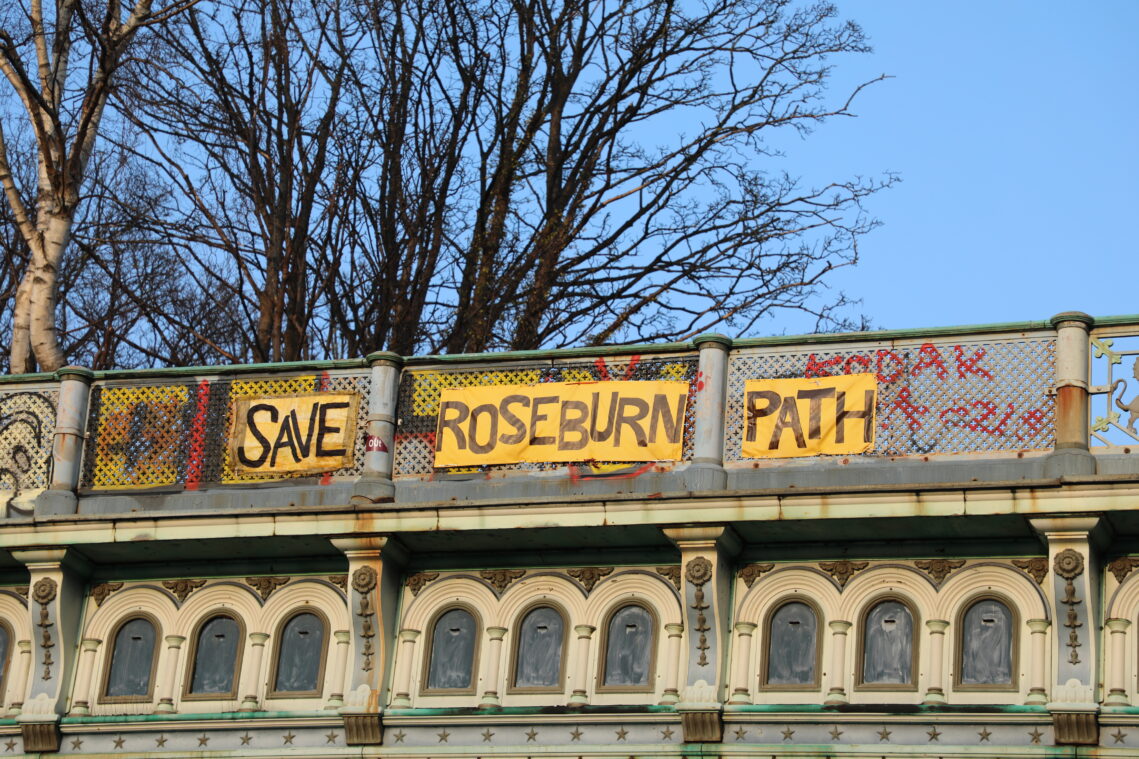
The feeling extends beyond Roseburn. In the west of the city, the Roseburn Path is one of a number of off-road routes through the city, created from former railway lines. It has become the focus of a campaign to protect what supporters call a “nature network”, rich in vegetation and wildlife, from the council’s potential plan to repurpose it as a tram line extension.
Meanwhile, in Corstorphine, The Accessible Corstorphine for Everyone group (ACE) raised concerns over the imposition of a Low Traffic Neighbourhood (LTN).
Initially introduced during the pandemic under the ‘Spaces for People’ programme, measures such as bollards and widened pavements were meant to be temporary, but many have been made permanent. Many residents say these changes have caused issues for drivers across the city.
David Lowe of the (ACE) Group pointed out that “Surveys were ultimately disregarded, silencing the community and undermining the democratic consultation process.” Despite overwhelming opposition from the community, the council ignored these voices.
It’s a familiar pattern in the city. Residents feel cast adrift as the council marches forward with plans that often fail to take local concerns seriously. In both Roseburn and Corstorphine, people say they were left behind in the name of ‘progress.’
Cycle groups like Spokes and Sustrans support the council’s broader environmental and net-zero ambitions, though not without reservations. Spokes stated that “CCWEL delivery suffered delays due to local objections, doubts by certain councillors and political groups. The project is not perfect, but it is a massive step forward and a substantial main-road space reallocation from car to active travel right in the city centre”.
For those caught in the tentacles of circumstance, the development agenda of the council feels trivial and the human cost too easily overlooked.
Although we all want Edinburgh to be a more modern, greener and more liveable city in future, for that to be achieved the Council must learn to listen to the people living in its present.


