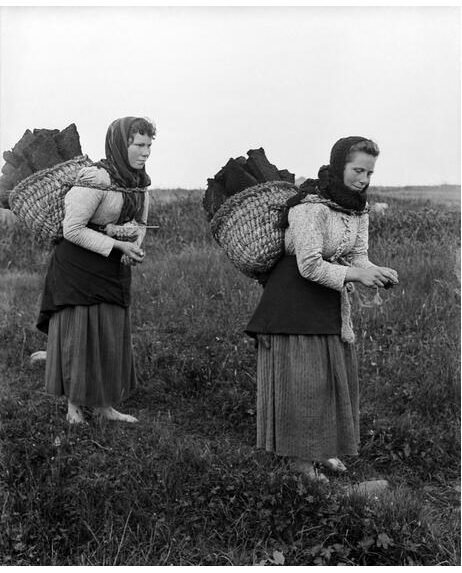
There is a photo of a woman pinned to my notice board. She’s bundled up in layers, a scarf wrapped around her head. Fastened around her shoulders is a basket laden with peat so heavy that she must arch forwards to counter it. She walks barefoot across the Shetland peatland. In her hands, she holds her knitting.
My fingers know how to type without looking at a keyboard, how to hold my phone to allow me to scroll through endless hours of social media. Her back may ache, and her feet may burn, but the the ability to knit is so ingrained in her fingers, it is second nature to create.
© Travel Press and Publicity, courtesy of National Museums Scotland.
When I picked up my knitting needles again last year, I was determined to make it a hobby I stuck to. This is the real difference between knitting in our generation and the previous ones – it is no longer a necessary domestic skill. For the first time knitting a jumper is not more economical than buying one. Why would you buy wool and invest hours of your time into knitting something that you can pick up off the shelf at Primark for £20?
Yet, every time I enter a shop and am confronted with knitwear hung row upon row, I think back to that photo, and wonder what else is being lost alongside this skill. So, I decided to join a knitting group at my local library. I won’t lie, I was incredibly nervous the first time I went. I convinced myself I was being silly, that I wasn’t good enough to be going, that I would walk into the room and they would smell me – the amateur – from a mile off. Instead, I was greeted under the warm lights to a noisy, bright and colourful room of people creating things with their hands, swapping stories, patterns, advice and laughter – with a warm cup of tea to wash it down.
Sat under the fluorescent lights of Newington Library, my coat hangs on the back of the seat, dripping the remnants of the evening weather into a pool on the carpet where several tables have been pushed together, people crammed tightly around them, wool spilling everywhere, comparing their creations. The only sound filling the space is the gentle hum of chatter accompanied by the clacking of needles every so often. Sharon, a warm lady who emulated a kindness that makes you bask in it as if it were sunlight, sat perched at the end of the table. Her bright yellow creation was splayed out over her lap as she twisted her needles together. She sits back and laughs out loud, exclaiming: “I’m not the best at knitting, I just really like coming here for the people.”
“Knitting doesn’t just weave together the threads of a jumper, but also the core of a community.”
Knitting has always been an integral part of society and is closely linked to and shaped by communities. It has a long history of shaping fashions, economies and even some laws. For example, in 1571, England introduced a law that said all males over six (excluding nobility) had to wear a knitted cap on Sundays. This was brought in to sustain the knitting industry and men who did not comply were fined. In Guernsey, a law was introduced that prevented fishermen from knitting during the hours of daylight as they began to neglect their fishing duties when they realised they could earn more from knitting.
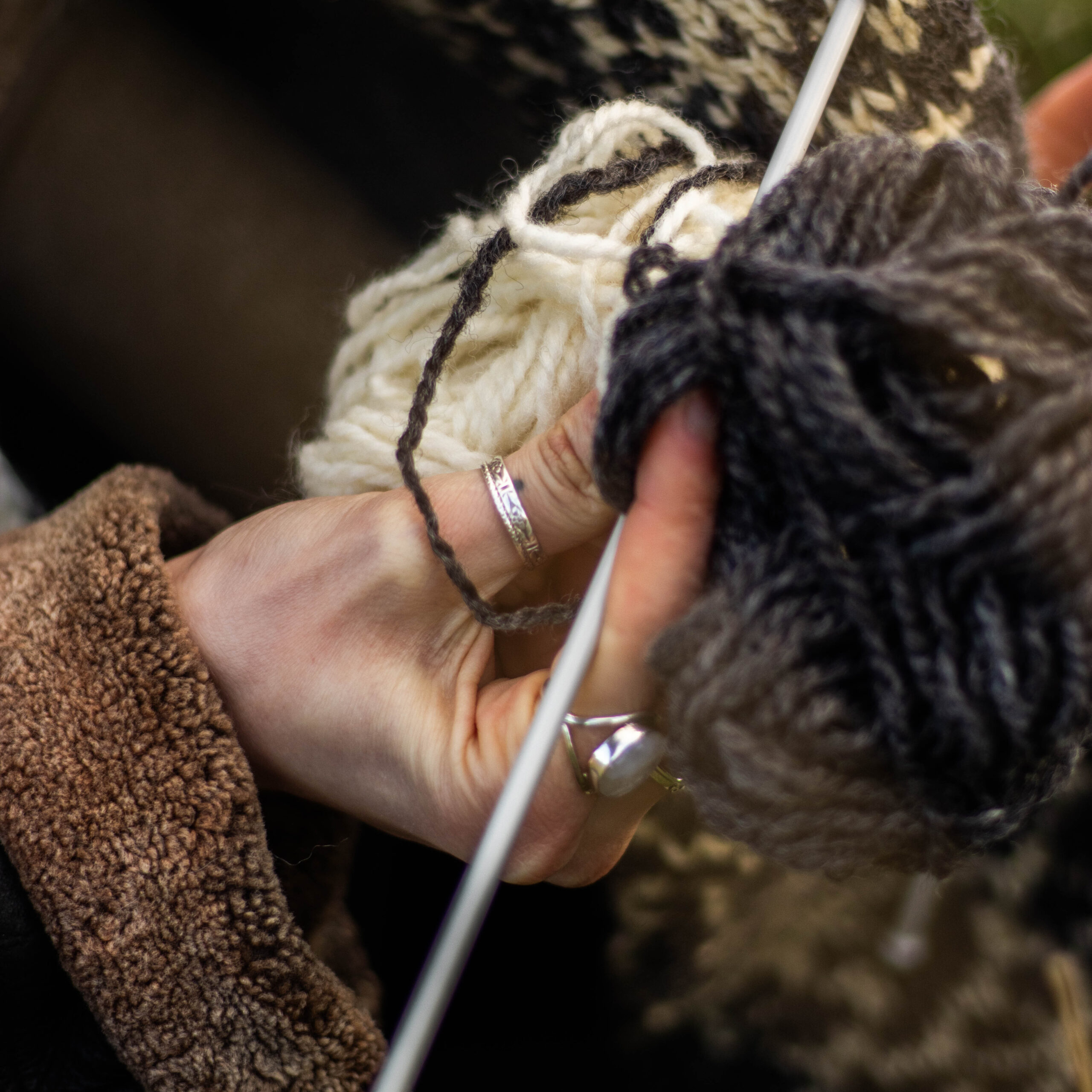
Sharing of patterns and trading knowledge is another way in which knitting has relied on community. A great example of this is the Gansey jumper, traditionally worn by fishermen, with each place having its own distinctive style. Mythology explains that this tradition existed so that if there was an accident, people would be able to identify where the drowned men had come from. These knitting patterns were developed through community and passed down generation to generation.
Communities have never been isolated or insular structures. This is what has led to such rich patterns being developed. Herring Girls were the women who travelled the Herring trail from Northwest Scotland all the way down to the Southeast of England following the herring fishers. They were essential to this fishing industry, many of whom could gut 40-50 herring per minute. As they travelled along the coast through communities, they would knit Gansey jumpers in their free time, being able to share patterns and expertise, and are thought to have influenced the development of patterns as they went.

I chase this instinctual need for community from my ancestors and find myself here, on a plastic library chair. Although the knitting club is a great place to ask for advice on tricky patterns, or share new stitches, I could technically get all of this information off the internet. If I kept knitting as a solitary activity confined to my bedroom, I would never have found out that Susan had her first ever chip butty when backpacking around Morocco in the 70’s after she met a Scottish couple who were travelling around in a chip van. The humble chip butty, the icon of British cuisine and she went all the way to Morocco to find one.
And then there is Carmen, a lively, bustling woman who has a special interest in wool spinning. She has spun wool out of bog cotton collected on the moors, human hair as a way of preserving it, and even dog hair. Yarn made from dog hair, also known as Chiengora, was an essential textile particularly used by the indigenous Salish people across the Pacific Northwest of North America before sheep were introduced by the Spanish.
You can’t share without being present with people. Yes, there are a million and one ways to stay in contact with people through social media, phoning and texting, but you miss the raw, organic moments that come from physically being around others. There is a privilege that for me, knitting is a hobby, something I do to disconnect from real life, rather than it being a domestic necessity. Yet I feel a sad loss at the disconnect we have from our clothing, and thus that lost knowledge that has been passed down generation to generation for thousands of years. Knitting doesn’t just weave together the threads of a jumper, but also the core of a community.