
Since Russia’s invasion of Ukraine in 2022, demonstrations in protest against the ongoing conflict have been a familiar sight across the Western world.
The format of the protests have been consistent, with calls for continued international support, denouncement of Russia and its allies, and chants of “Slava Ukraini!”.

That was, until Trump and his team went on the offensive in late February, souring relations between Ukraine and the United States ending with tensions imploding during that Oval Office meeting.
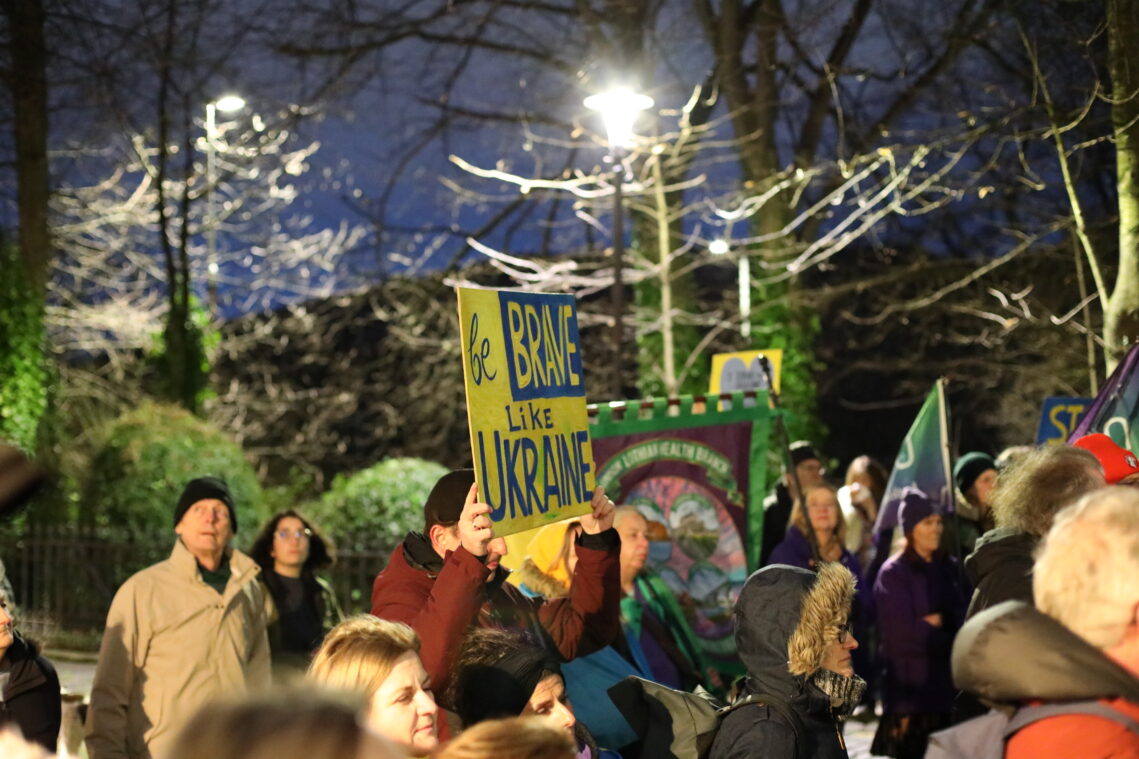
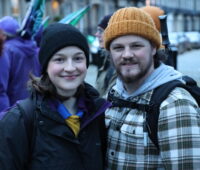
On March 5th, an emergency protest was organised by the Ukraine Solidarity Scotland group, to be held outside of the US Consulate in Edinburgh. Around a hundred people of various nationalities decried the heel-turn of what had previously been Ukraine’s most reliable ally, with community and public figures in attendance to give speeches over a loudspeaker.
This protest feels different to others. In contrast to the more subdued yet bereft Ukrainians, the majority of the protesters here, including many that have long supported the Ukrainian effort, unleashing their anger against the United States and the Trump presidency. It is understandable. The world’s most powerful country, and one of the United Kingdom’s oldest allies, is seemingly in the midst of abandoning a nation under attack.
“I’ve never felt more ashamed of my country,” says Alexis, an American student living in Edinburgh. “The way that Trump and Vance spoke to Zelenskyy is just absolutely abysmal, you shouldn’t speak to any leader of a country like that,” she adds.
Keir Starmer’s state invitation to Trump, made during his own Oval Office meeting held the day before Zelenskyy’s, is now being questioned in cities across the United Kingdom. Alexis’ friend, and fellow student, Hugh, says Trump would not be welcome in Scotland,“I don’t think he should be invited over to have those conversations if he’s not willing to settle for a peace deal with better terms that concentrate on security for Ukraine.”
As the sun begins to set, the demonstration is only getting started. A young curly-haired man with a Ukrainian flag draped over his shoulders runs to and from the speaker’s podium.
His name is Taras Harasym, the newly-elected president of the Ukrainian Society at the University of Edinburgh.
“It’s a shit show,” he says, “as they stand with Russia, they [the US] are willing to take any position that is more beneficial for them rather than for us.”
Pinning the flag to his chest is a “Free Azov” pin, representing the captured members of the controversial Azov military brigade, held by Russia since the Siege of Mariupol in 2022. While being one of Ukraine’s strongest military units, their ties to neo-nazi ideology has shrouded the group in notoriety.
Taras, from Lviv, was living in Ukraine when Russia’s full-scale invasion began and moved to Edinburgh almost three years ago. Though his disappointment at the current situation is clear, he is adamant that diplomacy, not hostility, is needed between pro-Ukraine parties and the United States. Unlike Hugh, Taras believes that Trump’s state visit should not be revoked.
“I know Trump is not a guy to change his mind or say something smart,” he says, “but having one more enemy—especially when it’s America who can be a great friend— is stupid, in my opinion.”
Taras’ friend Maxim, from Kyiv, shares a similar view.
“America is one of our greatest funds [sic],” he says, “not just in terms of money, but in intelligence too.”
Taras and Maxim clearly share the crowd’s ill-feeling towards Russia but are also nervous of alienating the US.
The stark difference, as was made clear by other Ukrainian demonstrators, are the personal experiences of those whose lives had been clearly affected by the war. To Ukranians, the war is not a newsreel; it is a question of life and death. It has marked their lives in ways most in Britain will never truly understand.



This disparity between locals and Ukrainians is exemplified by the Edinburgh branch of the Association of Ukrainians in Great Britain (AUGB), one of the most prominent Ukrainian organisations in the UK, choosing not to attend the march.
In a statement released on the day of the demonstration, the AUGB said “The [Ukrainian] Ministry of Foreign Affairs stated that the Ukrainian government’s priority strategy is NOT [sic] to hold demonstrations in front of the United States embassies and consulates. We call on everyone to support this position in this extremely difficult time for Ukraine.”
Taras, Maxim, and the AUGB’s desire to promote diplomacy as opposed to the hostility raises the question of whether Ukrainian views are truly being listened to by local organisers. Further highlighting this point is the minority of Ukrainians on the committee of the march’s organiser, the Ukrainian Solidarity Campaign, that initiated the demonstration.
This certainly isn’t to say their actions are misguided or in any way corrupted—their speeches at the demonstration clearly show they care—but it does raise the question of whether there is a disconnect between organisers and Ukrainian activists, as the messaging from the two groups is not aligned.
Understandably, most of the attendees here in Edinburgh are local. Being the capital and seat of power of the Scottish government, the city has hosted protests on a myriad of issues in Scotland. It is one of its biggest strengths; no issue is too small for people or too far away to band together and voice their support.
Perhaps it is time for a rethink from local organisers as to the goals of such demonstrations. Who are we to tell Ukrainians, who wake up every day anxiously checking if their loved ones are alive, what must be done to protect them? This war may be a global issue, but is at its core one nation’s struggle for survival.


