
In between rounds of our weekly pub quiz, my friend turned to me to tell me that her beloved Birkenstock Bend Lows were broken and that, shockingly, she is planning on taking them to a cobbler. “To where?” I cried. “ Are we living in the 1940’s?”. The word cobbler felt like a relic you might find in a black and white photograph, or on a war time poster. In my mind, broken shoes meant one thing: replacement. Scroll through options. Become overwhelmed. Buy the first pair you looked at. Problem solved. Her decision to choose repair seemed unorthodox – slower, more deliberate, and laborious.
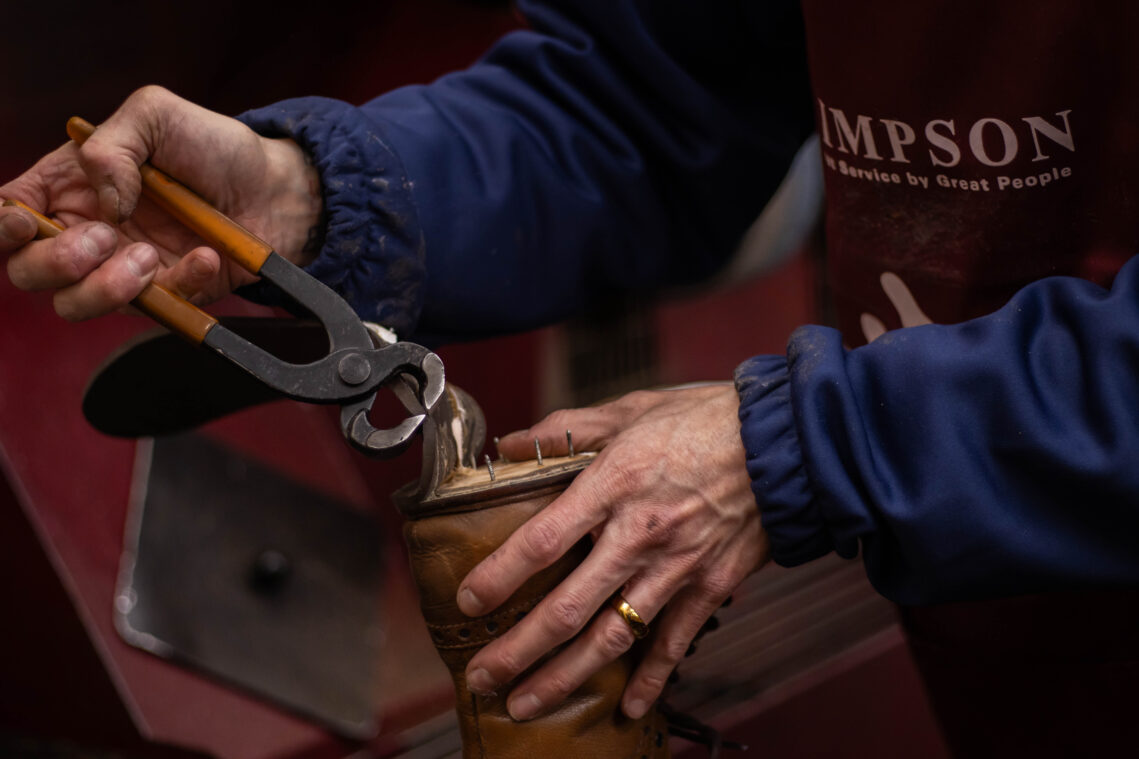
This conversation stayed with me long after the shame of losing the quiz had passed. Was the cobbler really a relic, or had we just stopped looking for them? The thought led me down a path of research which ultimately landed me on the digital doorstep of Mark Gibson, and potentially, an answer. Known as ‘Cobbler G’ online, Mark works out of a Timpson in Edinburgh and shares in depth videos showing the journey of shoe repair. From close-up resoling to stitching precision, his videos have all the hallmarks of satisfying content that punters love. The irony is evident. A traditional craft rooted in physical skill and patience finding new life online.
With a combined following of 525k across YouTube and TikTok, the shoe repair sensation fascinated me. A trade presumed to be in decline had garnered so much attention. Across the UK, 26% of consumers shopped at online fast fashion retailers Shein or Temu in 2023 alone. And, according to an Ibis World report the shoe repair industry revenue is expected to fall by over 3.1% annually from 2024-29. Shoe replacement has never been easier or cheaper – yet Mark is busier than ever.
Most of Mark’s clientele discover him through social media. It would be easy to read the irony as a contradiction. The man with the most analogue job going viral – a cobbler transformed into content. But Mark does not see it that way. When I raise it, he does not falter: “It’s bringing awareness to people that don’t realise that this trade still exists.”
He says, his silver YouTube plaque illuminating the wall behind him. In an attention economy built on constant novelty and disposability, a man resoling a boot in real time has amassed half a million followers. No quick fixes. Just hands on craft, up close and unhurried, watched by people who perhaps cannot quite explain why they are so engrossed. But Mark’s videos have the quality of something rare on today’s feeds: they take their time.
“What began as a provisional profession quickly became a passion.”
Is the appetite for slow living purely just for aesthetic content? Something to consume rather than practice? Mark seems aware of the line, even if he does not draw it explicitly. Social media platforms are a tool, he suggests. Useful when under control. It does not run his life, it simply adds to it.
He never intended to become a cobbler. Before he got tied up in repair, he studied audio engineering at university, hoping to build a career in DJing and sound production. When that path did not pan out, and a redundancy from a supermarket job forced a rethink, he took an interest in a vacancy at Timpson. What began as a provisional profession quickly became a passion. He stepped into the workshop and, in his words, “fell in love with it”.

Due in part to his fiercely loyal following, Mark’s day-to-day is relentless. As Edinburgh’s self-proclaimed busiest shoe repairer, he works through 10 to 20 pairs daily in his Rose Street workshop. “It’s just never ending”, he says, gesturing to the queue of worn leather waiting for resurrection. The boots, heels, and trainers sit in their ranks – covering the shiny floor round the back of the shop.
The shoe queue tells its own story about the industry’s journey, and Mark is candid about the damage done. Since the 90s, he explains, cheap imports have flooded the market – shoes you could buy for a tenner, wear once, and bin. Fast fashion gutted the trade. In America, he tells me, there were around 100,000 shoe repair shops in their heyday. Now, roughly 5,000 remain. The culprit, in his view, is construction. He reaches for a nearby boot and points to the stitched welt running along its edge – the mark of a Goodyear welt, the gold standard. Repairable, resistant, but increasingly rare.
I find myself looking down at my own feet. Desperately seeking Mark’s seal of approval, I slipped off my Birkenstock clogs for examination. I breathed a sigh of relief as he deemed them well made – humbly remarking that he has repaired “hundreds of them”. He tells me that Birkenstock even provides their own classic cork soles, making full reconstruction possible. “These ones are quite worn out”. I tittered as I lowered my shoes down – it is quite exposing to have someone intensely inspect the imprint of your foot in mouldable cork.
“There is a beautiful symmetry to it: a man who spends his days restoring other people’s treasured shoes, whilst using his precious time off to make tracks in his own.”
Although Mark has seen countless feet through the door, the work remains “super satisfying”. Each repair offers its own reward, especially when a pair carries a story with it. He sees a stark divide between the culture of fast, disposable fashion and the customers who choose to invest in pieces meant to last – people that hope to preserve something that matters to them. In his workshop, he has learned that shoes can hold more than just leather and laces; they can hold sentiment, history, and memory. In restoring them, he finds himself stitching together something greater than material seams.
Mark smiles as he recalls a recent customer who brought in a pair of Timberlands, purchased in the 1980s. The boots had been everywhere with him on his travels – a mobilising force and a loyal companion as he traversed the world. But they began to crumble. After being shunned to the cupboard for 15 years, they found their way to Mark’s workbench where they were carefully restored piece by piece. Upon their return, the customer was in disbelief. “He was crying”, Mark said. They were not just shoes anymore, they were a memory box – a souvenir of his favourite adventures.

Mark tells me another story about a man who arrived carrying a pair of his late father’s shoes. The father had recently passed away, and the son wanted to wear them himself: “They want to walk in their father’s footsteps,”
Mark explains. Bringing the shoes back to life, he says, is “definitely a nice thing to do… it’s very sentimental”. He admits that it is one of the best parts of the job.
Outside the workshop, Mark is deliberate about where his attention goes. Once a year, he and his wife carve out a fortnight entirely off social media for a conscious reset. “It can be quite a burden,” he admits, with the tone of someone who has truly felt the weight of it: “Choose your time wisely”.
It sounds simple until you try it. Mark’s antidote is not an expensive wellness retreat or a dopamine detox – it is the woods. He and his wife and their daughter walk. Around Scotland, up north, wherever the trip takes them. Nature, he says, is “definitely a good medicine”. There is a beautiful symmetry to it: a man who spends his days restoring other people’s treasured shoes, whilst using his precious time off to make tracks in his own.

He is not pushing for total disconnection. He still posts. He still scrolls. But he has made a decision – one that his customers, in their own way, seem to be making too. That some things are worth the slower effort. That not everything broken needs to be replaced. That there is, occasionally, a case for putting down the phone and picking up something worth repairing.


