For most of January and February last year I was unemployed, and so completely desperate to find a job. I knew I would be starting my Masters in the upcoming September, so I didn’t want anything too professional (as if finding that would have been easier anyway). A position in retail or hospitality was what I desired, something which could provide me with enough pennies to pay my mum rent, buy the occasional new outfit and go on a trip or two. What else could a 22-year-old girl on her gap year want? Well, let me tell you, the world did not want to give it to me.
Just a few months prior I had secured a temporary Christmas job in a matter of weeks by applying through the company website. There seemed to be so much choice on offer for the festive period. It lulled me right in, made me ignore that crucial word “temporary”. They want you so desperately in November, but by January 3rd it’s straight off the payroll. My decorations were down, and my cash was kaput. So, I started applying for jobs on Indeed.

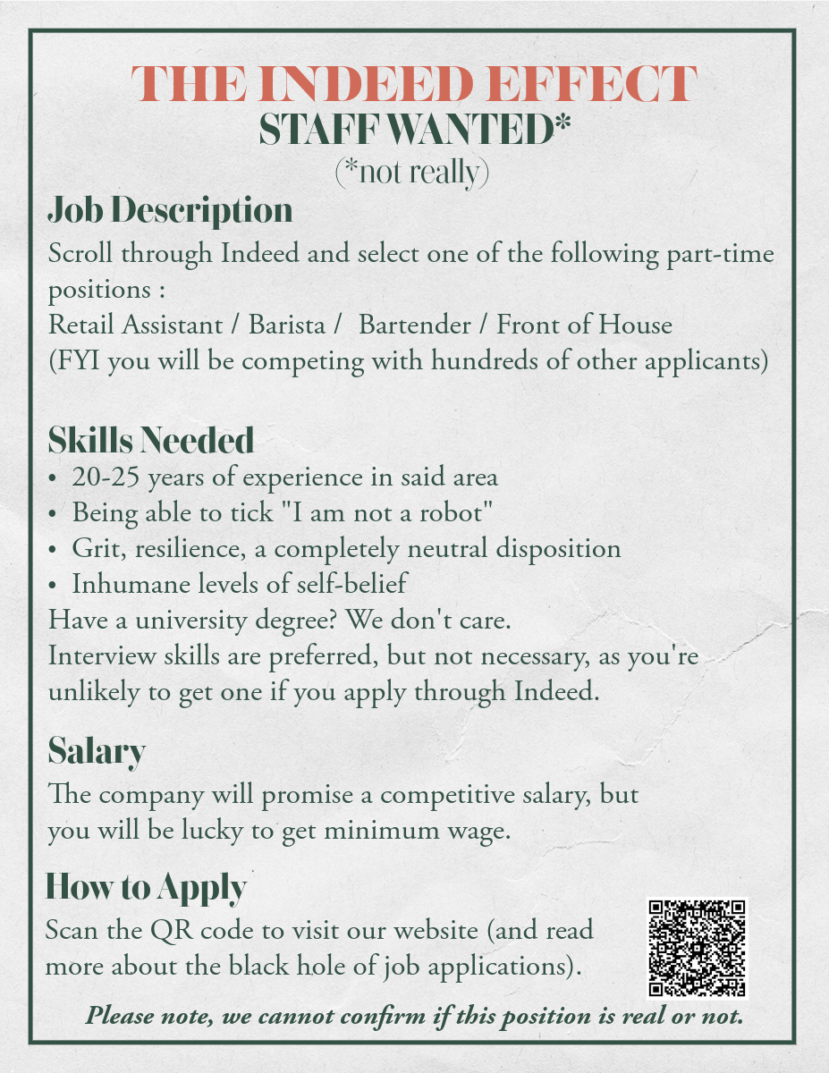
Every single day for most of those bleak months I would open a browser and apply to all of the jobs on offer in my preferred areas. I would sit, refreshing the webpage again and again to see if something new popped up. And that was part of the problem; there were hardly any positions on offer. Still, I must have racked up at least thirty applications, attaching a thoughtfully role-specific cover letter to each one. I did not receive one interview for any of these positions. Not one. I maybe got three emails back, weeks later saying the role had been filled, but that was it. I have a BA Honours degree, and I couldn’t even get an interview to work at the Co-op.
“We’re going to be a generation in debt before we’ve even reached thirty.”
I know speaking to a lot of people my age that this is a persistent issue. Our generation is continuously disheartened by the job market. I could gauge this in just fifteen minutes spent walking around our university campus. I asked students to describe, in a few words, how they feel about applying for any kind of job in the current job market. Regardless of whether the job was related to their degree or not, their responses were almost entirely negative. “Scary”, “unpredictable”, “disheartening” and “uncertain” were the responses of two acting students. A German exchange student studying publishing said she felt “really hopeless”. Other words used included “nervous”, “intimidated” and “completely horrified”. Only one student out of the ten I spoke to said they felt “hopeful”.
Indeed, is the number one job site in the world. It defines itself as “a global leader in job matching and hiring”. It promises to make people looking for jobs its priority. It has all the software, all the connections. It advertises on billboards and during breaks in streaming TV. Surely if you were to find a job anywhere, it should be through it. So why can’t we? The reason goes beyond the site’s failure to fulfil its purpose. Young people are living through a major job crisis – a consequence of the UK experiencing its highest rate of unemployment in five years. Almost weekly, a young person is featured on the news discussing their struggle to find employment.
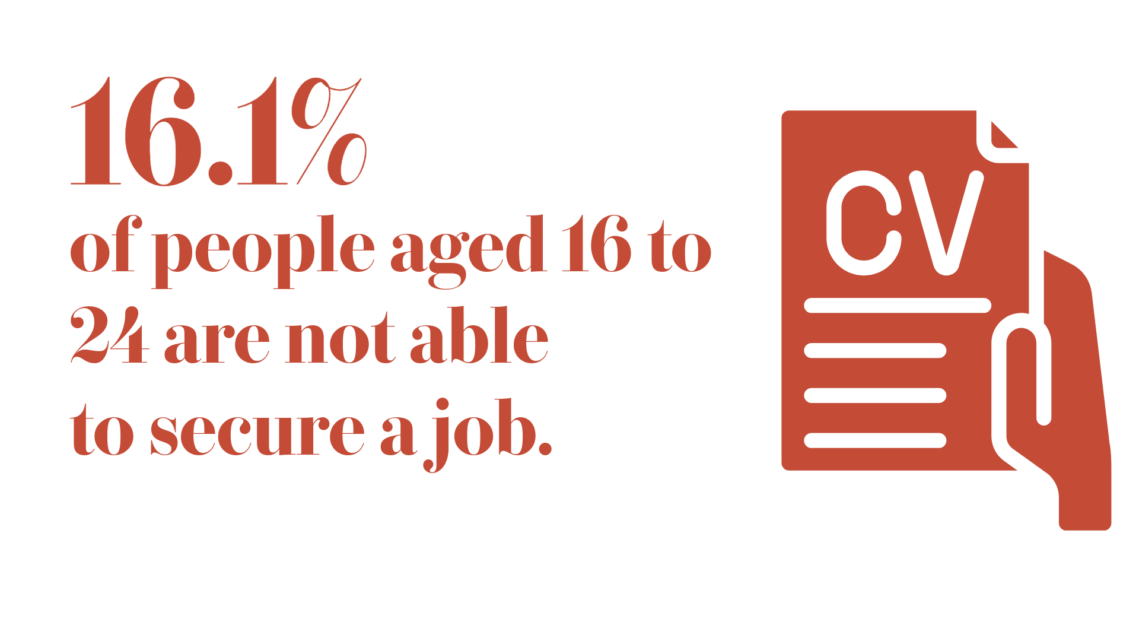
Entry-level positions are demanding levels of experience that are not possible to obtain when studying full time at university. On top of this, in England it’s likely that graduates will have to start paying back their student loans earlier. But without a job, it’s going to be extremely difficult to do this. We’re going to be a generation in debt before we’ve even reached thirty.
“I’m going to be expected to trust the internet and re-enter the black hole of application after application without response.”
However, it’s important to note that applying online isn’t the only way to secure a job. Towards the end of last February, I was on the bus home from a babysitting shift. After over a month unemployed, I’d had to revert to the job I did for pocket-money as a 17-year-old. Completely sporadic, definitely underpaid, but something that is at least semi-reliable in the sense that parents will always need people to look after their children. We were stopped at Holy Corner traffic lights when I noticed a sign in the window of card and gift shop Everyone’s Designs. They were looking for a part-time shop assistant, and asking anyone interested to bring in their CV. I had dismissed this as old-fashioned – there was no way I would get a job from actually going somewhere and asking. But my mum was ecstatic: “I’ve been telling you for weeks, you have to go and hand in your CV to places!” she said. “That’s how I got all of my first jobs!”
The next day I was trotting into the shop with my CV in a white envelope. Five days later, I had an interview. By the first week of March, I was standing behind the till with a staff number and my name on the whiteboard. The whole exchange had been done in person and via phone call – it was as if I’d been transported to the Bruntsfield that my mum lived in in the late 1980s. All those eight weeks of dud applications ended with me securing a job through a piece of paper blue-tacked to a window.
I’ve seen these types of adverts in multiple shops in the area in the last few months. My only guess for why is that employers want to establish a real, human connection with their potential employers. I understand that – I love that this is what they seem to be prioritising. But I can’t help fearing for when I start applying for a proper, adult job in the world of journalism. I’m going to be expected to trust the internet and re-enter the black hole of application after application without response.
Well, that’s if there’s anything actually real (human) to apply for at all.